

Many people have experienced the phenomenon of performing for an audience even when no one is around. This is “half-living”–being inauthentic, pretending to be something that we think will look good to others based on ideals we have in our minds.
More often, people have experienced the phenomenon of structuring dozens of their interests and even their personality around trends. The latter is harder to recognize, but certainly a much bigger problem, even if both phenomena have the same eventual product: a version of ourselves that is fake. What I’m interested in is the fact that everything around us seems to come from trends, because this greatly affects the authenticity of people. Who are we if we are only a product of what is spoon-fed to us?
The assertion has been made many times that social media creates a facade, a barrier between real life and this other colorful, better, constantly perceived life. However, social media is now generating trends that bleed into every aspect of life. There is no longer a barrier. Even non-users of social media are prone to the totality of their spread. My aunt has deleted every form of social media, but since cowboy boots are trending, they’re appearing more outside of phones. She has begun to want them.
The never-ending number of trends creates the “half-living,” where nobody can be deeply themselves because everyone is becoming the same. Obviously, there have always been widely-followed trends, but now they are more infectious due to the internet. Clothing, music, books, and even ideas trend online, and suddenly everyone is doing the exact same thing in the same way for the same reasons.
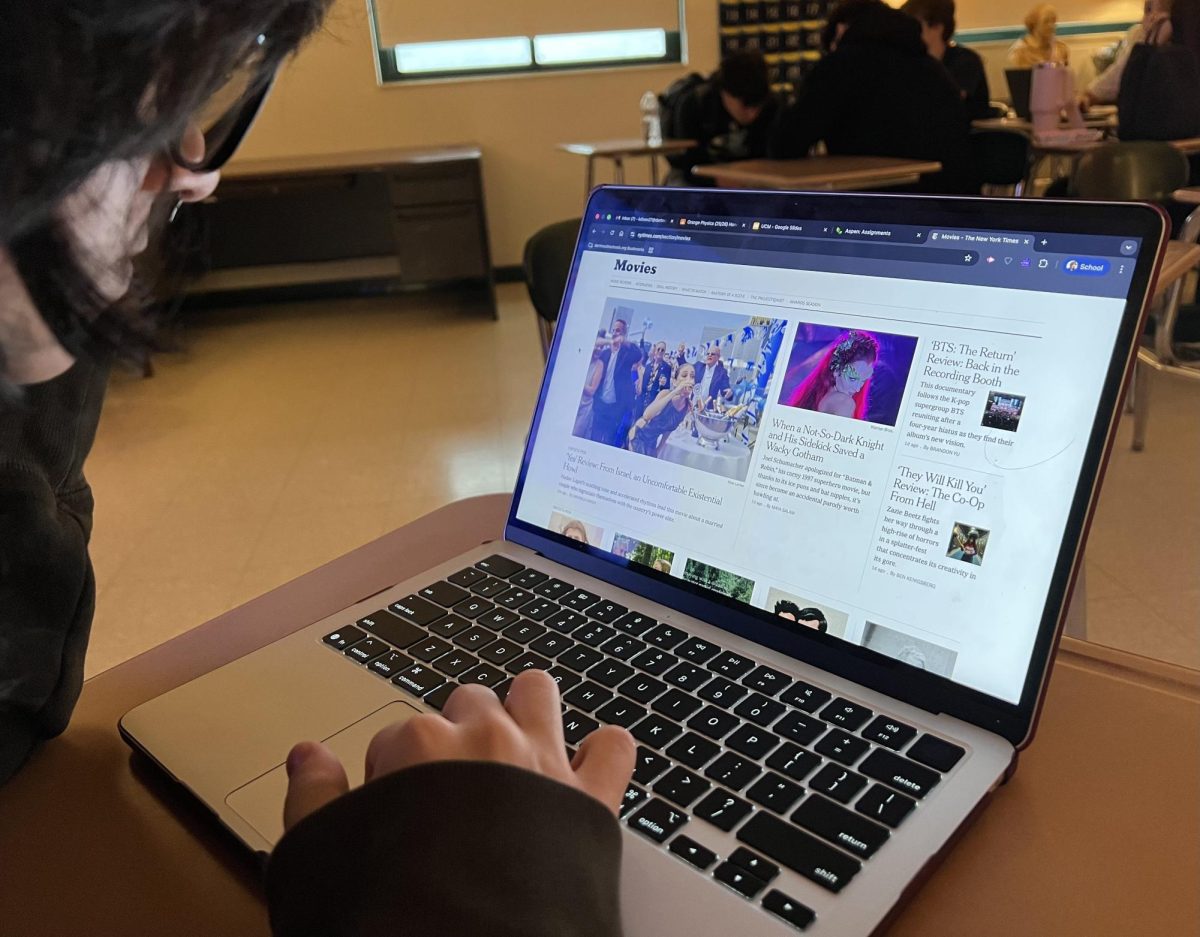
Millions are likely to see the same posts about these four things (clothes, music, books, ways of thinking) with the same exact commentary, and suddenly nobody is experiencing any of them in a way that is personally meaningful or a reflection of themself. They (trends) are limiting diverse exposure, says writer Wilmien Boss. The posts tell you how to consume, behave, dress, and think without you even knowing it. Everyone is identical to everyone else. This is likely due to a constant stream of messaging from exposure to endless short-form content. There is too much in front of us to consider.
Lately, people don’t have a chance or are not willing to consider expressing themselves in any way other than what the internet tells them. Every second it seems that there is something new trending. Millions want the same Owala, the same new bear cup from Starbucks, the new tote bag from Trader Joe’s, a $130 Parke mockneck, the same vintage Coach bag, the same Brandy Melville top, and jorts. Millions use the same song (“My Own Worst Enemy” comes to mind). Millions read the same authors because they seem to be the only ones being recommended, like Colleen Hoover and Sarah J. Maas.
These few trends do not even begin to explain how fast-paced and convincing the internet is. They are at the very surface. Social media algorithms can quickly convince consumers that these things are their favorite items of all time and that they must have them, and must have anything their phone tells them. It subliminally tells people what they should desire and makes them believe that they had the idea and the free will to buy it. It tells them that it fits their “aesthetic.” It gets rid of discernment between the self and trends.
There is also an attempt at counterculture, which has happened countless times in a pre-social media world. Now, it’s fiercely occurring on the internet in response to the dominant culture and values popular trends have pushed. People oppose the pop music coming out, the books that everyone has read, and the clothes that everyone wears. They trade them for things that are deemed niche by the internet. People riot when a song they like that wasn’t previously trending on TikTok becomes popular, claiming it’s ruined. People throw the word “poser” or “newgen” around, asserting directly or indirectly that the other person likes something because it makes them look cool and because it’s currently trending, while they like it because it’s a true representation of their interests and because they’re a real fan. People read difficult classics instead of romance and fantasy novels, and listen to underground or not-trending music instead of Sabrina Carpenter. They create shame around listening to released music instead of unreleased tracks by an artist. Most of all, they form their own pocket–one of superiority complexes.
There was recently a trend celebrating “nerding out,” and immediately, this portion of the internet was shaming others for their interests not being nerdy enough. Countless videos were made satirizing the people that had posted something that wasn’t their idea of nerdy. (Obviously, I’m not speaking of people who put Starbucks as something that is nerdy, but of people who were not “different” enough for others.)
This part of the internet comes from the desire to be effortlessly cool, but also from wanting to differ from the “typical” masses. Unfortunately, even these people are usually not as different as they’d like to believe. Most times, the people who strive the hardest to appear different and superior on the internet are also following a trend that popularized once-obscure things. While the trends they follow may be less popular than the most mainstream ones, they are trends nonetheless. Crucially, these people who claim to be different and truly aren’t are the ones that are rude to others about being “average.” There are genuinely unique people all over the internet, but these are not the ones.
Because the truth is, once many things hit the internet, millions see them, and they are no longer obscure, because this is the function of the internet–connectivity and the sharing of information that attempts to enrich lives. Without this, people otherwise would not have had access to learning new things. This leads me to one point: it is not bad to learn something new from the internet. One group cannot hold superiority over another if they are all accessing new information from the same source.
But yet another point is that while the counterculture of striving to be unique aims to branch outside of boxes, it in fact puts people into them. As I touched on when speaking about the most popular trends, the internet counterculture trend also causes people to become the same, pushing videos to a point where ordinarily smart people cannot think for themselves, which is most likely owed to screen time and screen addiction (when one is addicted to a screen, as the algorithm aims for, one is being inundated with content at such a magnitude that it becomes difficult to think critically or deeply). These people are essentially being fed content that tells them to act superior. Enjoying calling your interests more niche than other peoples’ comes to mind. (Niche has become an enormously popular vocab word.)
Everyone, I have noticed, has been a victim of trends at one point. That includes myself, when I was listening far more to trends and not taking a step back to form my own opinions. I would end up thinking I had an original idea, when in fact I had seen it on my phone because it had become popular. At one point, when I was in middle school, I redecorated my room “cottage core” mostly because other people had done it. Around the same time, I used to think the majority of my music was diverse, while the majority of it was in fact songs that were trending, with some of my own taste interspersed within.
I do not know exactly how to remedy this phenomenon, but I know that it saddens me to see everyone slowly becoming more the same in an unnatural way. Humans are surprisingly (or maybe unsurprisingly) similar. We have experiences that we don’t believe anyone has, when in reality we all do, and we can find solace in that. We instinctively react and behave in the same ways, ways which sometimes remind us that we are all in fact animals. We all know the ache of love and the ache of pain and both lead to the greatest art. We are all curious and have the potential for friendship and kindness. The desperate striving for uniqueness has a quick cure. It is to remember that we are more alike in some ways than we are different. People must become natural and feel more openly again, and the internet strips this away.
Another thing I hope for is for people to refrain from putting complex humans in boxes. This is not the fault of individuals sometimes, but more the fault of the internet. Still, it can be stopped. People can read War and Peace and listen to Dua Lipa. Humans are not meant to follow the linear path trends set them on, but instead be a paint palette of interests. If people can willfully think more individually while they are on social media or even break away from it, we might have the ability to branch out as individuals and become unique people, without trends. Everyone is unique in many ways, interests, hobbies, even the degree and way in which we feel. No two people feel something the same or even see the world the same, because everything happens through the lens of their own mind. This needs to be remembered. And if we stray slightly away from watching things mindlessly, we can also remember what we actually want instead of what we are told to want.
Both uniqueness and similarity are inherent, and the balance of both is wonderful if embraced. We only have to arrive back at where we once came from.







samuel brodsky • Dec 23, 2025 at 11:52 am
Great ideas here. It feels like you might have more than one article here though.
Internet sameness resonates with me. I thought the Internet was going to connect disparate people around the world. Instead it makes us all do the same dance and drink from the same cups.
Rebirth of nerdy as cool is also a pet peeve of mine. Everyone now claims to be a nerd but they really weren’t/aren’t.